You’ve put a lot of work into considering your academic path ahead and you bring a unique set of experiences and academic history to the application process. At the Faculty of Medicine, our priority is to encourage and support diversity throughout our evaluation of applications to the MD Undergraduate Program to create a more inclusive, caring community of students who will go on to become an empathetic, diverse group of doctors in the future.
In our evaluation of applicants, we consider the whole person and that includes a blend of academic criteria and non-academic experience. Becoming a doctor requires unique traits and qualities of compassion, empathy, determination, curiosity and a desire for excellence—there is no ‘ideal’ preparation or institution that is preferred for the UBC Medical undergraduate program.
We encourage you to explore the evaluation process and connect with us at any point if you have questions. The Admissions team is here to support you throughout the preparation of your application to the MD Undergraduate Program.
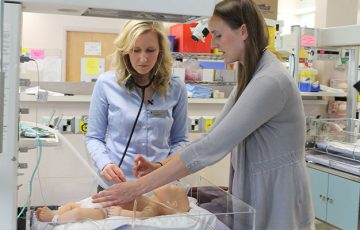
Kamloops pediatric teaching
Academic Criteria
Being evaluated can feel challenging but know that we have put in place a fair and equitable process in order to evaluate your academic history. There are many details to understand, so we’ve tried to present them as simply as possible.
How we calculate and evaluate your academic history
About your Grade Point Average (GPA):
Your GPA will be determined through these calculations:
- Overall academic average (OGPA):
The OGPA calculation is based on all university transferable courses attempted with letter or percentage grades1, excluding courses taken in the summer of the year of application2. - Adjusted grade point average (AGPA):
If you are eligible for the AGPA calculation, up to 30 credits from the academic year with the lowest academic average will be dropped. If more than 30 credits are presented in the lowest performing academic year, up to 30 credits with the lowest grades will be removed, provided 90 graded credits remain. Courses taken in the summer of the year of application do not count toward the AGPA. Courses in progress during the application cycle (i.e., courses taken during the fall and winter terms after you submit your application) also do not count toward the AGPA. Courses must be completed prior to the summer of application to count toward the number of credits needed to be eligible for the AGPA.
About your overall academic average and adjusted academic average calculations:
1 AP, IB and A Level credits are not included in GPA calculations.
2 Courses taken during the summer of the application year are treated as courses in progress. They are excluded from academic average calculations and do not count toward the credits needed for the AGPA, but will ultimately count for credit toward the minimum 90 credits with grades needed to enter the MD program (as long as the courses are graded). Summer courses with grades from past years are included in the academic evaluation.
GPAs are calculated the same way for all applicants, with the exception of disability-related accommodations granted in coordination with the Centre for Accessibility. Exceptional circumstances that are not adjudicated by the Centre for Accessibility are not considered for academic accommodations.
Adjusted Academic Average Calculations Examples
The application system will calculate your GPA for each academic year (September to August) and will identify the year with the lowest GPA. If you are eligible for the AGPA, up to 30 credits from that year will be excluded and the GPA will be recalculated.
GPA Scenarios
To determine your eligibility, here are various GPA examples:
Example 1:
GPA credit total = 90
AGPA is not applicable to this applicant
Example 2:
GPA credit total = 105
Lowest year credit total = 33
105 – 90 = 15, so we will remove up to 15 credits from the worst year
Example 3:
GPA credit total = 120
Lowest year credit total = 33
120 – 90 = 30, so we will remove up to 30 credits of your lowest year of academic performance
Example 4:
GPA credit total = 108
Lowest credit total for the year = 18
108 – 90 = 18, so we will remove up to 18 credits of the worst year (in this case, the entire lowest year of academic performance)
Example 5:
GPA credit total = 152
Lowest year credit total = 30
152 - 90 = 62, we will remove up to 30 credits of the worst year (in this case, the entire lowest year of academic performance)
Please note that not all applicants who are eligible for the AGPA will have 30 credits dropped from their lowest year. The number of credits dropped depends on:
- the total number of credits with grades the applicant has completed prior to the summer they apply;
- the number of credits in the lowest year;
- the arrangement of credits and grades within the lowest year.
Courses are dropped from the lowest year in order of grades, starting with the lowest grade.
Example 6 – Lowest year contains a small number of credits
This applicant has completed 150 credits with grades. The academic year with the lowest average is shown below.
Course Grade Credits
ENGL 145 82% 3
ENGL 196 87% 3
This applicant will have ENGL 145 and ENGL 196 dropped. No courses from any other academic year will be dropped, because courses are dropped from the lowest year only.
Example 7 – Lowest year contains a course or courses with a large number of credits
This applicant has completed 120 credits with grades, and the academic year with the lowest average is shown below.
Course Grade Credits
PHRM 215 81% 15
PHRM 262 82% 2
PHRM 254 83% 15
PHRM 225 85% 2
CHEM 239 88% 1
BIOC 240 88% 3
PHRM 280 Pass 1
This applicant will have PHRM 215 (15 credits) and PHRM 262 (2 credits) dropped. No further courses will be dropped due to the credit value of the course with the next lowest grade, PHRM 254. As PHRM 254 is a 15-credit course, dropping this course would mean that over 30 credits would be dropped (15 + 2 + 15 = 32).
Example 8 - Lowest year contains a course or courses with a large number of credits
This applicant has completed 114 credits with grades, and the academic year with the lowest average is shown below.
Course Grade Credits
BIOL 128 78% 3
BIOL 187 87% 2
ARTS 001 95% 25
This applicant will have BIOL 128 (3 credits) and BIOL 187 (2 credits) dropped. Dropping ARTS 001 would mean the applicant has fewer than 90 credits with grades remaining (114 – (3+2+25)=84), so ARTS 001 will not be dropped.
How the adjusted academic average calculation works:
- the academic year is considered to be the beginning of September to the end of August;
- credit totals are calculated using courses with grades only (no pass/fail, no thesis courses without grades, etc.) and are converted to UBC units. This applies to both the credit total of the lowest performing year and the GPA credit total,
- if the academic year with the lowest academic average includes more than 30 credits, no more than 30 credits (those with the lowest grades) will be excluded,
- if the academic year with the lowest academic average includes less than 30 credits, no further additional credits from other years will be eliminated,
- if an applicant has more than 90 credits following removal of the worst year up to 30 credits, no further additional credits from other years will be eliminated,
- if any English or Indigenous Studies courses are eliminated from the AGPA calculation, these do not have to be retaken.
About Grade Conversion
These Grade Conversion Tables will be used to convert your letter grades to a percentage. Depending on the grading scheme of the institution attended, each letter grade on your transcript will convert to the equivalent percentage grade as per the appropriate table. These conversion scales were approved solely for use in academic evaluations of applications to the UBC MD Undergraduate Program. The resulting averages may differ from those calculated by your institution. Grades from schools using a percentage system will not be converted.
These tables can be used to convert grades from your transcripts to the percentages shown. This will assist in determining your eligibility for the UBC MD Undergraduate Program. However, you should be aware that in the event of a discrepancy between your calculations and those of the MD Admissions Office, our decision is final.
Note: Table 1 is used for institutions that award an A+; Table 2 is used for institutions that do not.
| Table 1 | |
| Letter Grade | Converted Value |
| A+ | 95 |
| A | 87 |
| A- | 82 |
| B+ | 78 |
| B | 74 |
| B- | 70 |
| C+ | 66 |
| C | 62 |
| C- | 58 |
| D+ | 54 |
| D | 50 |
| D- | 46 |
| F | 25 |
| Table 2 | |
| Letter Grade | Converted Value |
| A+ | n/a |
| A | 95 |
| A- | 82 |
| B+ | 78 |
| B | 74 |
| B- | 70 |
| C+ | 66 |
| C | 62 |
| C- | 58 |
| D+ | 54 |
| D | 50 |
| D- | 46 |
| F | 25 |
GPA Calculator
For your reference, you may find it helpful to use this GPA calculator. When calculating your GPA, please refer to the Academic Criteria above.
MCAT Scores
The minimum MCAT requirement for applying to our program is a total score of 496 on one exam. Applications that do not have at least one exam with a total score of 496 will be made ineligible. Please review our statistics for an indication of competitive scores. Please ensure your MCAT exam dates are valid.
If you have written the MCAT more than once, we will evaluate the exam with the highest total score of 496 or higher. Please note that our evaluation is based on only one exam; we do not take sub-scores from individual sections of different exams.
Pre-Interview
The cut-off for invitation to interview is based on a score derived from applicants’ Overall Academic Average or Adjusted Academic Average (if applicable) and a Non-Academic Qualities score. At the pre-interview stage, academic and non-academic scores are weighed equally. MCAT scores are not a factor in deciding who is invited to interview so long as minimum score requirements have been met.
Post-Interview
At this stage, all aspects of your files are reviewed together. The Admissions Selection Committee will consider whether you have demonstrated that you are likely to perform well in the rigorous curriculum and case-based format of the MD Undergraduate Program.
Non-Academic Criteria
The UBC Faculty of Medicine is comprised of a diverse community of people from around the world, and we want our future students and doctors to be as diverse as the communities they will end up serving. In an effort to select well-rounded, mature, empathetic and caring individuals who will be best suited for success in medicine, your non-academic qualities (NAQ) are given significant weight in our evaluation.
To determine your NAQ score, we look at a number of criteria, including:
- Paid employment
- Volunteer and unpaid experiences
- Life experiences
- Hobbies and interests
- Research
- Awards
- Indigenous Applicant Essay, if applicable
- Black Applicant Essay, if applicable
- Rural and Remote Suitability Evaluation, if applicable
If you are invited to interview, we also consider:
- Interview outcomes
- References
Non-Academic Categories
The Non-Academic Activities section allows applicants to demonstrate who they are outside of their studies. NAQ evaluations are based on the following five categories: leadership, service ethic, capacity to work with others, diversity of experience, and high performance in an area of human endeavor. To determine your NAQ score, we consider a variety of factors including, but not limited to, the length and depth of your involvement, your level of responsibility, and the degree to which you actively engaged in work that expanded your perspective and understanding of others different from yourself.
We specifically value non-academic experiences and activities which demonstrate the following aptitudes: selflessness, the willingness to undertake unglamourous work in service to a greater goal and/or to act as a contributing and reliable member of a team, humility, resilience, dedication, motivation, grit, social concern & responsibility, team work, creativity, determinedness, scientific & intellectual curiosity, generosity, an interest in continuous learning, maturity, integrity, and realistic self-appraisal, among other qualities. Non-academic experiences do not need to be directly related to medicine in order to demonstrate these qualities. In fact, participating in paid or unpaid experiences with organizations that are directly engaged in providing on-going service to the community, can often provide applicants opportunities to demonstrate these traits in ways that make meaningful impact.
The MD Undergraduate Program highly values paid employment, as employment demonstrates important traits including commitment, professionalism, reliability, and time management. We also value intentional community involvement through volunteering and unpaid work in organizations with on-going community impact that outlast any one person’s participation. Applicants are advised to seek volunteer opportunities through existing organizations before founding their own service club or organization in order to make the greatest impact in their communities.
The Admissions team is unable to provide advice as to which activities applicants should participate in in order to receive a high NAQ score. Instead, we advise you to pursue activities that are of particular interest to you and that you can imagine committing a significant amount of time and energy to.
Please note that just as applicants are required to demonstrate above-average academic abilities, a strong NAQ score requires demonstration of above-average non-academic qualities.
Physician Shadowing
In accordance with the guidelines put forward by the College of Physicians and Surgeons of BC, the MD Undergraduate Program discourages individuals not enrolled as students of health professions regulated by the Health Professions Act or Emergency Health Services Act from participating in physician shadowing. Such activities pose significant concerns to patient privacy and confidentiality and will not result in an increased NAQ score or improved chances of admission.
About Verifiers
Verifiers for non-academic experiences can be contacted at any time from the date of application submission until the time that an offer of admission is made (typically May- June of the year of entry). Verifiers are contacted to confirm specifics of an activity and can also be contacted at random. Discrepancies between the details in your application and those confirmed by the verifier are noted and may affect your application status. Applicants are required to ensure that all the information they provide on their application is accurate. To ensure that you are accurately representing your experiences, time commitment, and involvement in all of your non-academic activities, we strongly recommend that you contact your verifiers in advance of submitting your application.
Northern and Rural Pathway
Applicants interested in pursuing medicine in northern, rural or remote communities are encouraged to complete the Northern and Rural Pathway section of the application, used to help determine the suitability of applicants for the Northern Medical Program and a select number of positions in the Southern Medical Program, the Island Medical Program and the Vancouver Fraser Medical Program - Fraser Learning Community. Experiences in rural, remote, northern, and/or Indigenous settings, along with community ties and relevant activities, factor into this assessment. Learn more about the Northern and Rural pathway
Interview
Our invitations to interview are based on the results of both the academic and non-academic elements of your application. Our interview process follows the Multiple Mini-Interview (MMI) model, which connects you to approximately ten different interviewers and requires you to respond to carefully pre-selected questions/scenarios within a determined time frame. The interviewers are from diverse geographic areas of BC, and typically consist of clinicians, academics, community representatives, and 3rd or 4th year UBC medical students. Learn more about the interview process.
Final Selection
The selection of candidates for admission to the UBC Faculty of Medicine MD Undergraduate Program is governed by guidelines established by the UBC Senate and is the responsibility of the Faculty of Medicine Admissions Selection Committee and the Associate Dean, Admissions. The selection process reflects the values of the UBC Faculty of Medicine and all university partners in the UBC distributed MD undergraduate program. The process is designed to choose well-rounded students from a variety of backgrounds who meet the goals of the expanded, distributed program; who can be expected to perform well in the rigorous curriculum and case-based learning format; and who can balance and enrich their academic experience with strong non-academic skills and interests.
The UBC Faculty of Medicine’s Vice Dean, Education oversees the selection process to ensure that all applicants are given careful consideration without regard to age, gender, sexual orientation, race, ancestry, place of origin, family status, physical or mental disability, political belief, religion, marital or economic status. The selection of candidates is made by consensus of the Admissions Selection Committee. Preference is given to residents of British Columbia. Up to 10% of seats (maximum of 33 in 2025/2026) may be available to out-of-province applicants in the medical program each year.
Each year, our admissions process is highly competitive. Due to the intense competition, and limits on the incoming class size, not all qualified applicants will be offered admission. Please know that your application is important to us and we encourage you to consider applying again even if your past attempts have not been successful.
Site Preference
You will have the opportunity to indicate your site preferences after your interview. Members of the Selection Committee are not aware of an applicant’s site preference during the selection process. Following an admissions decision, you will be allocated to sites based on your preferences. Your site choice is given priority, unless the available positions at that site have been filled, in which case you will be added to a waitlist for your preferred site(s). Acceptance of admission to the MD Undergraduate Program is always site specific.